Why Dreams Speak in Symbols
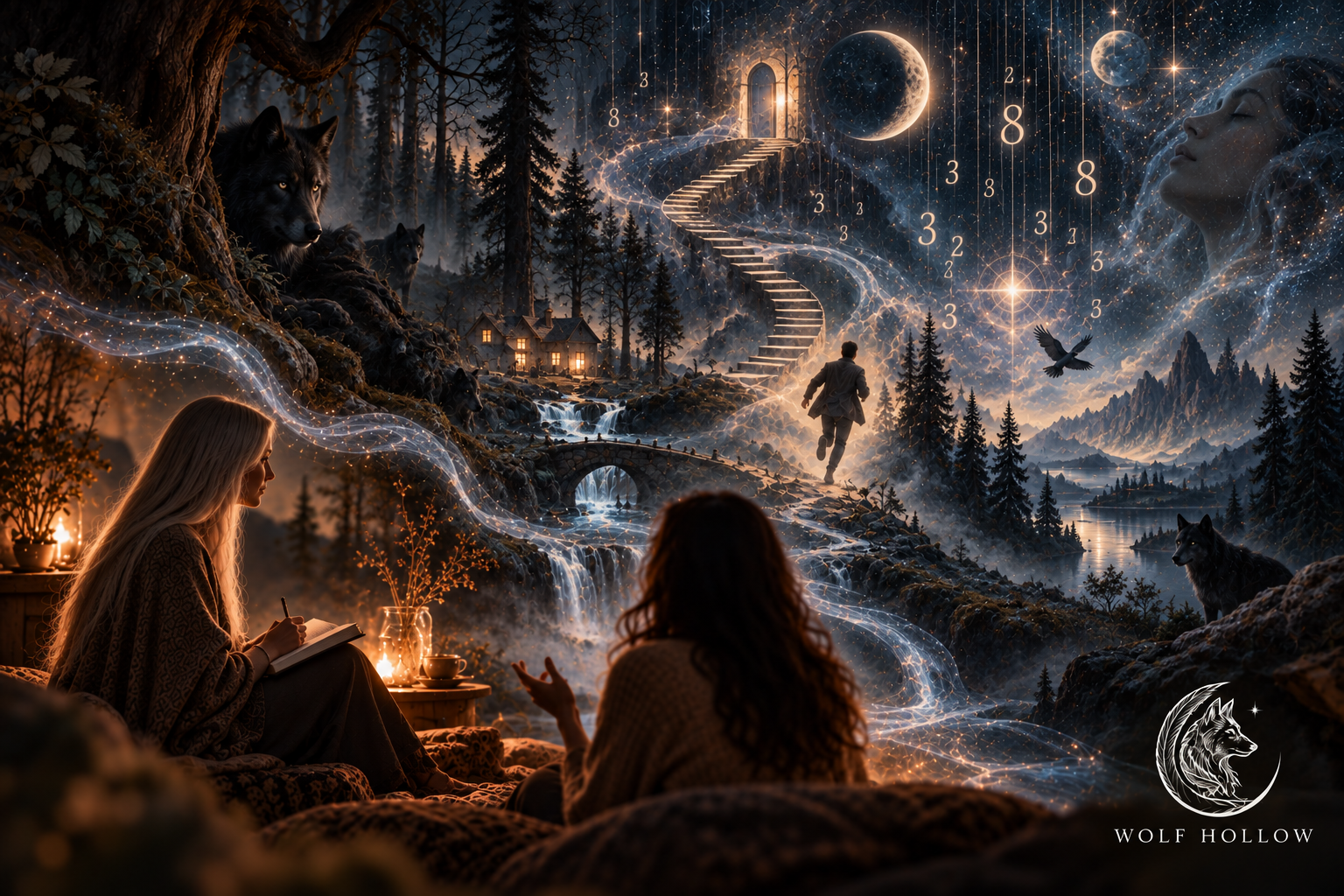
Dreams rarely speak in the linear language of the waking mind. They speak through image, symbol, emotion and metaphor — the language of the unconscious is the language of Nature. In Jungian psychology, a dream is not something to decode through a fixed dictionary of meanings, but something to enter into relationship with.
The more we engage, journal, ask questions.. the more the dreamtime responds.
A wolf appears at the edge of the forest. A river rises beyond its banks. We wander through a house filled with rooms we have never seen before. A child is lost. A stranger arrives. Someone is chasing us. We find ourselves standing at the edge of an ocean, unable to cross...
The dreaming psyche could simply tell us what it wants us to know. But it rarely does. Instead, it gives us an image because symbols are the language of dreamtime. Symbols are the language of Nature.
Carl Jung understood symbols as something very different from signs. A sign points toward something already known: a red light means stop. However, a symbol carries something we do not yet fully understand. It gathers meaning around itself. It opens rather than closes. It invites us into exploration of meaning and it is deeply layered. There is no dream dictionary available that could possibly ever unpack the infinite layers of a symbol and find ways for how each symbol relates to the individual, or the collective.
A wolf does not simply mean instinct. A house does not always mean the self. Water cannot be reduced to emotion or the unconscious. These associations can offer us a place to begin, but the living symbol belongs first to the dreamer. What was the wolf doing? Were you afraid of it, following it, feeding it, running from it? Was the house your childhood home or somewhere you had never been? Was the river clear or muddy? Were you drowning in it, watching it from the bank, or being carried somewhere by its current? The details matter because the psyche is not speaking in definitions. It is speaking in relationship.
The dream knows more than the waking mind for the dream time has access to all the layers of the unconscious – from the personal to the collective, even to the archaic.
One of the things I find most beautiful about dreams is that they often seem to hold something our conscious mind has not yet been able—or willing—to see.
We may believe we have moved on from something, while night after night we return to the same house. We may think we have become independent, while a forgotten child keeps appearing in our dreams. We may believe we have let go and yet we are desperately trying to control where a car is taking us in the dreamscape. We may have spent years living from the mind while animals begin arriving at the edges of the dream, carrying something older, wilder and more instinctual.
The dream does not necessarily contradict the conscious mind. It brings forward what has been left behind, forgotten, shamed, repressed, suppressed and masked.
And sometimes a symbol returns again and again because our relationship with it is still unfolding.
In my thirties I often dreamed of bears chasing me through forests and orchards and I remember trying to climb trees in pursuit of safety. Now, when bears and I meet in dreamtime we say "hello", we invite each other to share, we connect.
The symbol is alive in the psyche. It evolves alongside us. Its meaning changes as we change.
The forest that once terrified us may later become a place of refuge. The wolf we once fled may eventually walk beside us. The river that threatened to sweep us away may become the very thing that carries us home.
This is why working with dreams is less about asking: What does this symbol mean?
and more about asking: What is my relationship with this image? What does it stir in me? Where does this live in my life? What might the psyche be trying to bring into consciousness?
And perhaps most importantly: What happens if I stay with the image rather than rushing to explain it?
Because sometimes the symbol itself is the medicine. Sometimes the messages are clear. Other times, they are an invitation to go deeper.
Not something to solve.
Something to listen to.
Something we can carry with us as we go about our waking lives and simply observe how it feels to hold it inside our hearts, a part of our psyche. And gently observe what synchronicities unfold in response.
Because dreams don't stop speaking to us upon waking. They live in the psyche, the self. Dreams live in you. They are a part of you and when those parts are recognized and related to once more, the world will find ways to reflect them back to you in greater and greater wholeness of who you truly are.